In the industrial landscape of Egypt and the wider MEA region,ABB panel builders in Egypt growth is the ultimate objective. However, success often brings a hidden challenge that many facility managers and factory owners overlook until it is too late: the electrical bottleneck. As your production capacity increases, so does the demand on your infrastructure. If your foundation isn't ready, your growth will eventually hit a ceiling.
Imagine the scenario: Your business is thriving, and you have just invested in a high-capacity production line to meet increasing demand. The machinery arrives, and the technicians are ready, but the moment you power up, the system fails. This is a classic case of an electrical distribution panel being treated as a static piece of equipment rather than a living part of your business. Many systems are built only for yesterday’s needs, not today’s expansion.
We believe that your success shouldn't be sidelined by a power outage. Designing a system that is "just enough" for right now is a common oversight that leads to expensive downtime, lost revenue, and frantic emergency calls. True professional planning involves partnering with expert electrical panel builders in Egypt who view your current facility size as just a starting point, not the finish line.
The difference between a standard installation and a future-proof one lies in the strategy behind the build. Most industry experts focus on the immediate cost of the enclosure and the breakers. However, seasoned leaders in the electromechanical field know that the real value is found in scalability. This article will guide you through the essential steps to ensure your electrical infrastructure can handle whatever the future throws at it—whether that is a new factory wing or a complete automation overhaul.
By focusing on modularity, smart testing, and high-quality components from partners like ABB and Borri, you can build a system that grows alongside your ambitions. Let’s look at how you can avoid the "tear-down and start-over" cycle and instead create a power foundation that is as limitless as your business goals.
The "Growing Pains" of a Successful Business
In the fast-moving industrial sectors of Egypt and Africa, expansion is a sign of health, but it often places an immense strain on existing infrastructure. For many facility managers, the realization that their power system is inadequate comes at the worst possible moment: during the commissioning of new equipment. This "electrical bottleneck" is a silent growth killer. When your electrical distribution panel reaches its thermal or physical limit, you aren't just facing a technical issue; you are facing a complete halt in your return on investment.
Often, the problem starts during the initial design phase. Standard may focus solely on the current load requirements provided in the initial tender. While this fulfills the immediate contract, it ignores the reality of evolution. We have observed that a factory’s power needs rarely remain static for more than three to five years. Whether it is the addition of a new HVAC system, a specialized CNC machine, or an automated packaging line, each addition draws more from the "heart" of your facility.
To avoid this, a shift in mindset is required. Instead of viewing your panel as a fixed cost, view it as a scalable asset. A professional, future-ready build ensures that your facility can adapt to market demands instantly. By anticipating these "growing pains" before the first wire is even crimped, you protect your business from the logistical nightmare of a full-system shutdown later down the road. True reliability isn't just about keeping the lights on today; it’s about ensuring they stay on while you grow tomorrow.
The 20% Rule: Why "Just Enough" is Never Enough
In the world of professional engineering, there is a significant difference between a system that "works" and a system that is "reliable." One of the most critical strategies employed by veteran electrical panel builders Egypt is the implementation of the 20% Rule. This principle is simple: you should never design an electrical distribution panel to operate at 100% of its physical or electrical capacity from day one.
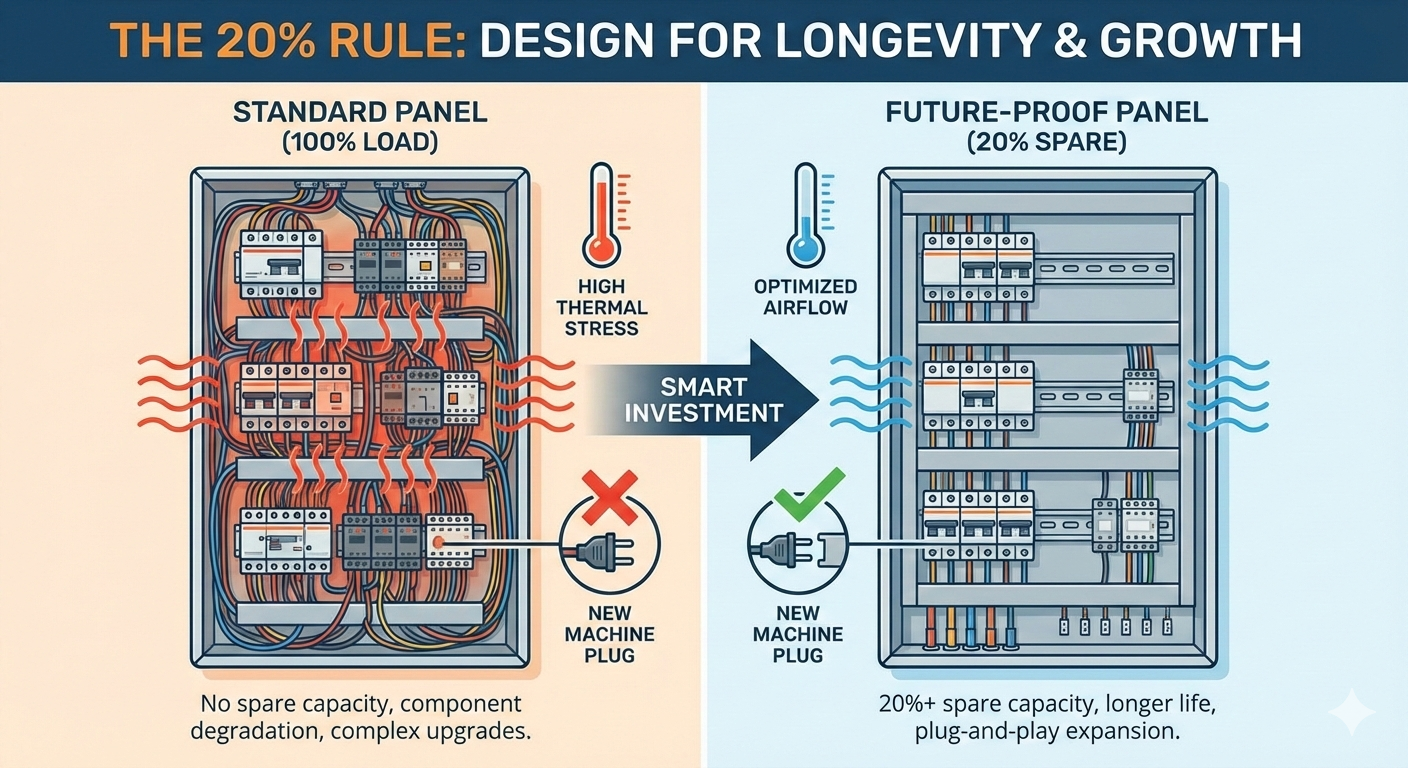
When we consult with facility managers across the MEA region, we often explain that an electrical panel is like a set of lungs. If it has to breathe at maximum capacity just to keep the building running, it has no "reserve" for sudden exertion. Leaving at least 20% to 30% spare capacity is not a luxury; it is a professional safeguard that addresses two major industrial risks: heat and future costs.
1. Thermal Management and Longevity
Electricity produces heat. When a panel is crowded with components and running at full load, the internal temperature rises significantly. High heat is the primary enemy of electrical longevity. It causes insulation to become brittle and sensitive electronics—like the advanced controllers from ABB or Borri—to degrade prematurely. By ensuring there is extra physical space and busbar capacity, you improve airflow and heat dissipation. This means your components run cooler, stay within their optimal performance parameters, and last years longer than they would in a "cramped" environment.
2. Eliminating the "Small Project" Headache
Consider the cost of adding just one new motor or a small HVAC unit to your floor. If your panel is at 100% capacity, that "small" addition suddenly requires a massive project: a new enclosure, new cabling, and a total plant shutdown to integrate the new system.
However, if your electrical distribution panel was built with spare slots and rated for a higher current than currently needed, that same addition becomes a simple, one-hour task. You avoid the cost of new infrastructure and, more importantly, you avoid the cost of downtime. We use Odoo to track these spare capacities for our clients, ensuring that when they are ready to grow, we know exactly what their "headroom" looks like without needing to perform a full audit every time.
Modular Design: The Strategic Advantage of Scalability
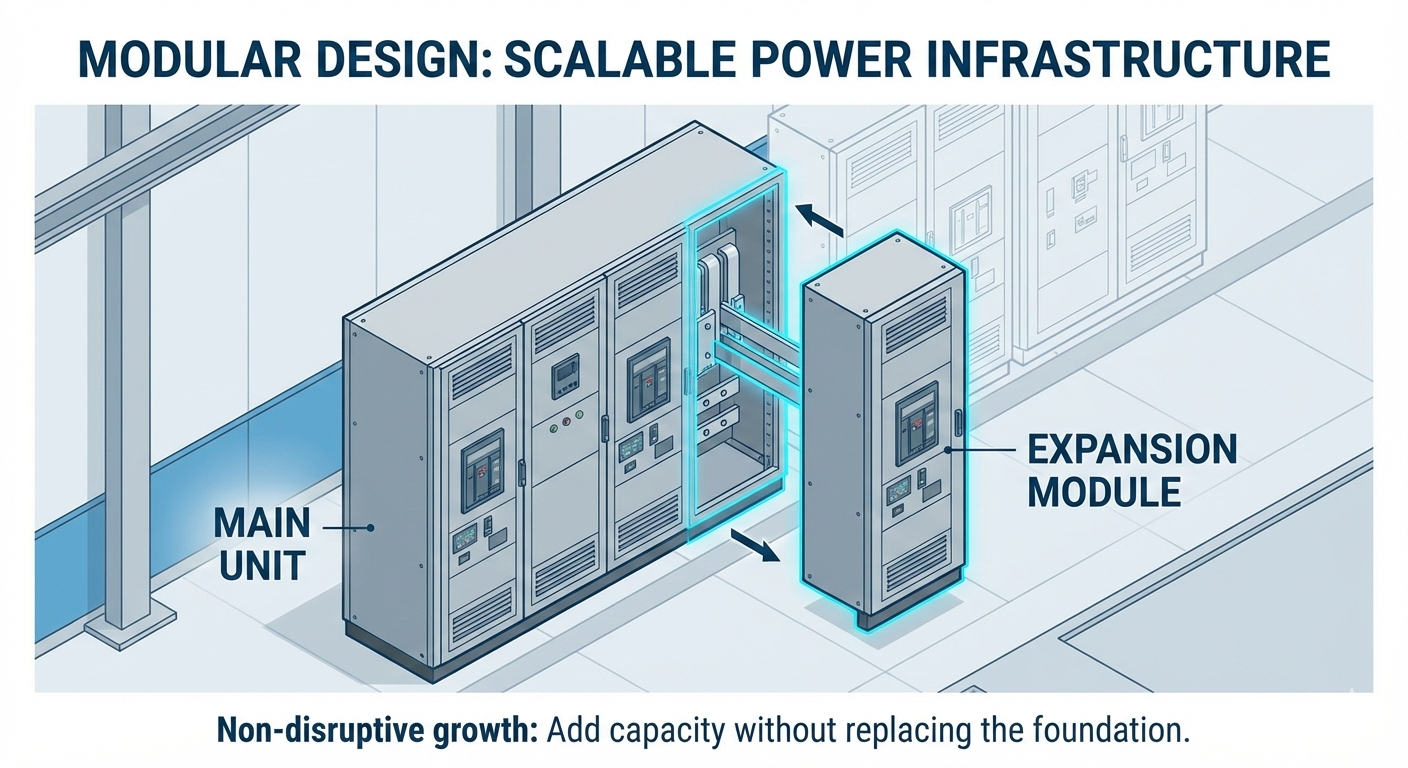
When planning for industrial expansion, the physical structure of your power system is just as important as the electricity flowing through it. Traditional electrical panel builders panel builder often provide "fixed" enclosures—solid steel boxes that are difficult and expensive to modify once installed. We advocate for a different approach: Modular Design.
Think of a modular electrical distribution panel as a "Lego" system for your factory’s power. Instead of one giant, unchangeable unit, the system is composed of standardized sections or "cubicles" that can be joined together. This design philosophy is a game-changer for facility managers in the MEA region who need to stay agile.
The Benefits of "Snapping On" Power
| Advantage | Impact on Operations |
|---|---|
| Reduced Downtime | Joining a new module is significantly faster than a traditional installation since main busbars are designed to be extended. |
| Space Efficiency | Modular panels can be configured in "L" or "U" shapes to fit specific footprints, maximizing electrical room space. |
| Standardization | Consistent parts from leaders like ABB make future maintenance or replacement straightforward without custom one-offs. |
By investing in a modular foundation now, you ensure that your facility is never held back by its own walls. You gain the freedom to grow at the speed of your business, knowing your power infrastructure is ready to move with you.
Data-Driven Expansion: Utilizing Smart Monitoring
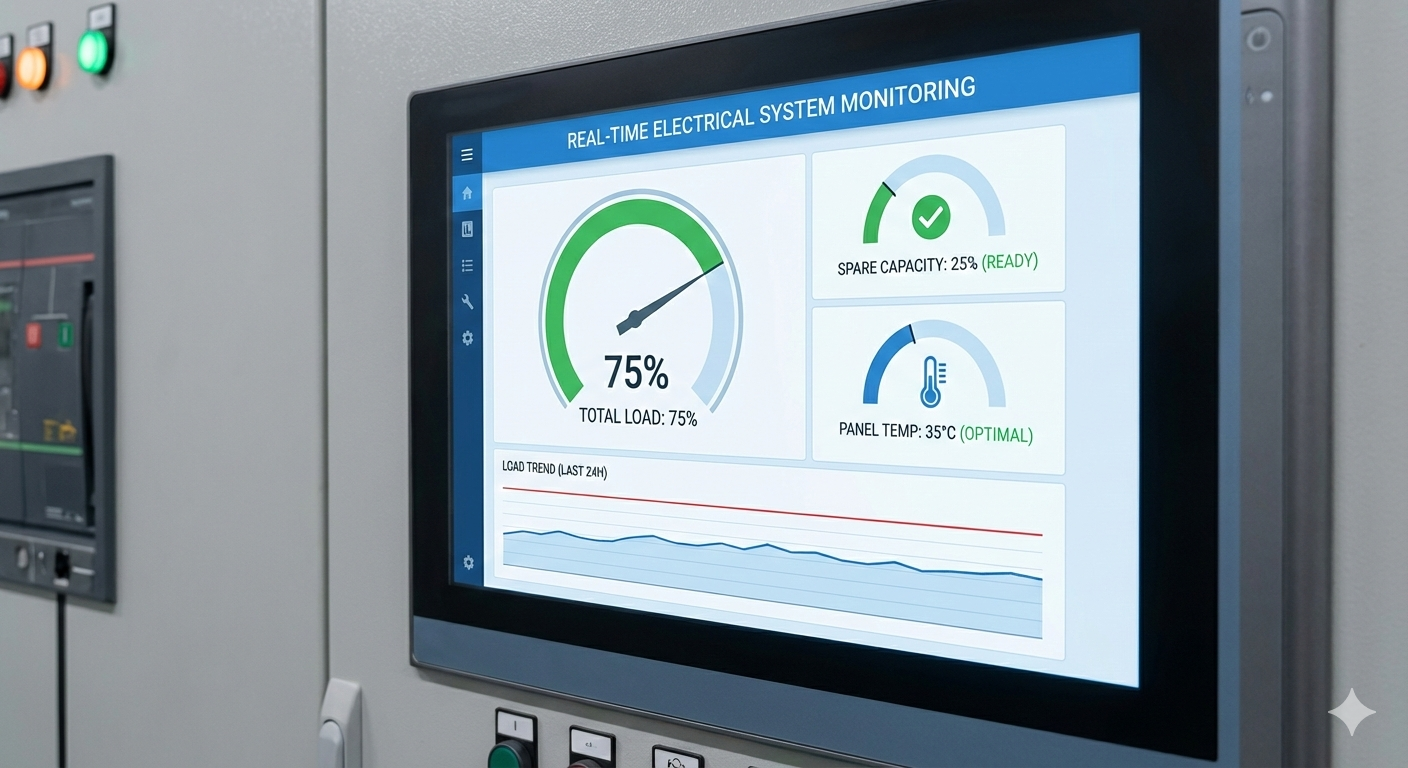
In a modern industrial environment, guessing how much power you have left is a risk no professional should take. Traditionally, facility managers only discovered their electrical distribution panel was overloaded when a breaker tripped or, worse, when a component failed due to overheating. Today, expert electrical panel builders are moving away from "reactive" maintenance and toward "intelligent" power management.
We integrate smart monitoring tools directly into our panel designs. By utilizing digital power meters and IoT-enabled sensors, we turn your distribution system into a source of live data. This transparency is essential for any business planning to scale, as it provides a clear picture of your "spare capacity" in real-time.
Why Data is the Key to Growth
- Identifying Bottlenecks: Before you buy that new machine, you can check your data to see if your current electrical distribution panel can handle the specific "inrush current" without affecting other sensitive equipment.
- Energy Efficiency: Data often reveals "phantom loads"—equipment that is drawing power even when it shouldn't be. Cutting this waste frees up capacity for actual production growth.
- Predictive Maintenance: Smart sensors can detect subtle increases in heat or harmonic distortion. This allows you to fix a minor issue during a scheduled break rather than dealing with a catastrophic failure during a peak production shift.
The Advantage: Odoo Integration
What sets our approach apart is how we handle this information. By leveraging Odoo-managed systems, we can help you archive and analyze this data over months or years. This isn't just about looking at a screen; it’s about having a documented history of your power consumption. When it comes time to expand, you don't need to hire a consultant to perform a week-long energy audit. You already have the reports ready.
Building a "smart" panel means you are no longer flying blind. You have the mathematical certainty required to make bold business decisions, knowing exactly how much power you have in reserve to support your next big move.
Retrofitting: An Economical Path to Increased Capacity
There is a common misconception in the industry that scaling up your power always requires a "scrap and replace" strategy. Many facility managers believe that once an electrical distribution panel reaches its limit, the only solution is to buy an entirely new system. However, for a growing business, this can be a logistical and financial nightmare involving long lead times and extended plant shutdowns.
As experienced electrical panel builders, we often recommend retrofitting as a highly effective, professional alternative. Retrofitting is the process of upgrading the internal "organs" of your existing panel—such as breakers, busbars, and protection relays—while keeping the original steel enclosure and main cabling infrastructure intact.
Why Retrofitting Makes Financial Sense
| Benefit | Description |
|---|---|
| Minimal Downtime | Because we aren't ripping out the entire cabinet or rerunning main supply lines, the "switch-over" time is significantly shorter. |
| Compliance Upgrades | Allows older panels to meet modern ISO 9001:2015 standards and local Egyptian safety codes with arc-flash protection. |
| Increased Performance | Replacing inefficient components with modern, low-loss alternatives increases usable power in the same footprint. |
Retrofitting is the professional’s secret to sustainable growth. It proves that scaling your business doesn't always mean starting from zero; sometimes, it’s about making what you already have work harder and smarter for you.
The Reliability of Global Partnerships (ABB, Borri, Pelsan)
When you are scaling a facility, the components inside your electrical distribution panel are more than just parts—they are the guarantee of your uptime. A common pitfall for some electrical panel builders is to cut costs by using "generic" or "white-label" components. While this might look attractive on a quote, it creates a massive risk for a growing business. We have spent over a decade proving that your growth must be built on a foundation of global excellence.
Our strategic partnerships with industry giants like ABB, Borri, and Pelsan are not just about brand names; they are about long-term scalability and support.
Why "Standardized" Means "Scalable"
- Global Availability: By using ABB switchgear or Borri power solutions, you are using parts that are standardized globally. Whether you are expanding in Cairo or across the MEA region, you can find matching components easily.
- Tested Compatibility: These global leaders spend millions on R and D to ensure their products work together seamlessly. This reduces the risk of technical glitches or "harmonics."
- High Performance: Standardized components are built to withstand the harsh industrial environments of the Middle East, including high ambient temperatures and dust.
Investing in global quality today is the only way to ensure that your expansion tomorrow isn't held back by a missing, obsolete part.
Conclusion: Engineering for Longevity and Growth
In the competitive industrial sectors of Egypt and the MEA region, your electrical infrastructure is more than just a utility—it is a strategic asset. As we have explored, the difference between a facility that thrives and one that struggles with downtime often comes down to the quality and foresight of your electrical distribution panel. By shifting the focus from "minimum requirements" to "maximum scalability," you are essentially buying an insurance policy for your company's future.
Building for growth doesn’t mean overspending; it means investing wisely. Whether it is through adhering to the 20% Rule, adopting a modular design, or integrating smart monitoring for real-time data, the goal is to create a system that stays ahead of your ambitions. Partnering with expert electrical panel builders who prioritize global standards and genuine components from ABB and Borri ensures that your foundation is as solid as your business goals.
Our mission is to ensure that your operations run smoothly, safely, and without technical headaches. We believe that your success is our success, and a well-engineered panel is the first step toward that shared goal. Don't let your electrical system be the ceiling that limits your growth. Instead, let it be the engine that drives you forward.
FAQs
What is the "20% Rule" in electrical panel design?
The 20% Rule is a professional engineering standard which dictates that an electrical distribution panel should never be designed to operate at 100% of its physical or electrical capacity from day one. By leaving 20% to 30% spare capacity, you ensure the system has a "reserve" for sudden growth, improves airflow to reduce heat, and allows for the plug-and-play addition of new machinery without requiring a full system overhaul.
How does modular design help my factory scale?
Unlike traditional "fixed" enclosures which are difficult to modify, a modular design uses standardized sections or "cubicles" that can be joined together. This "Lego-like" approach allows you to add new power modules quickly as your factory expands, minimizing downtime and allowing the physical layout of the panel to fit the specific footprint of your electrical room.
Is it possible to increase my power capacity without replacing the entire panel?
Yes, through a process called retrofitting. If the "internal skeleton" or busbar system of your existing panel is in good condition, expert builders can upgrade the internal components—such as breakers and relays—to higher ratings. This allows you to increase capacity and meet modern safety standards while keeping the original steel enclosure and main cabling, saving both time and money.
Why is thermal management so important for industrial panels?
Heat is the primary enemy of electrical component longevity. When a panel is crowded and running at maximum load, internal temperatures rise, causing insulation to become brittle and sensitive electronics to fail prematurely. Providing extra space and capacity improves heat dissipation, ensuring that high-quality components from brands like ABB and Borri stay within their optimal performance parameters for years longer.
What are the advantages of "smart monitoring" for a facility manager?
Smart monitoring integrates digital power meters and IoT sensors to provide real-time data on your power consumption. For a facility manager, this data is invaluable for identifying electrical bottlenecks before they cause a failure, discovering "phantom loads" that waste energy, and performing predictive maintenance to fix minor issues during scheduled breaks rather than during peak production.
Ready to Build for the Future?
Contact our expert engineering team for a consultation on your next distribution panel.